Home

4. May 2026 22:05
by Rene Pallesen
0 Comments

China 2026 Xizhou

4. May 2026 22:05 by Rene Pallesen | 0 Comments

Xizhou – The Bai Way of Living A short drive north of Dali brought us to Xizhou — and once again, it

A short drive north of Dali brought me to Xizhou — and once again, it felt like stepping into a different world.

This is the heartland of the Bai people, one of China’s recognised ethnic minorities, with a culture, architecture, and identity distinct from the Han majority.

And you see that difference immediately as the architecture here is deeply rooted in tradition.

Many of the homes are constructed using a mixture of earth, straw, and other local materials — a form of rammed earth or adobe — designed to regulate temperature and withstand the elements. 

In one wall, you could clearly see fragments of old pottery embedded within it — broken pieces reused as part of the structure. Whether for reinforcement, drainage, or simply practicality, it gives the sense that nothing was wasted. Materials were recycled long before it became a modern concept.

Over the top of these walls sits the defining finish: a white lime or chalk wash. This isn’t just for appearance — it acts as a protective layer, helping to seal the surface and reflect heat, preserving the structure beneath.

The result is the signature look of Bai villages — clean white walls, often contrasted with darker timber frames and intricate decorative details.


The Bai are also known for their indigo-dyed textiles — a tradition that goes back centuries.

Historically, natural indigo dye was extracted from local plants and used to colour fabrics in deep, rich blues. Traditional techniques often included resist-dyeing methods — where parts of the fabric were bound, stitched, or pressed before dyeing to create patterns.

What we commonly see today as “tie-dye” is actually a continuation and evolution of these traditional resist-dyeing techniques. While modern versions may be adapted for tourism and contemporary tastes, the roots are very much authentic.

So yes — while the patterns you see today might feel stylised, the underlying method and cultural significance go back generations.


What made Xizhou stand out most was the atmosphere.

Compared to Dali’s ancient city, it was noticeably quieter. Fewer crowds, fewer distractions — just narrow laneways lined with whitewashed walls, leading past doorways and into glimpses of everyday life.

Looking into the courtyards, you could see the care people put into their homes. Plants, decorations, well-maintained spaces — a sense of pride that’s hard to fake.

Some of the houses were genuinely beautiful — not in a polished, tourist-ready way, but in a lived-in, authentic sense.


Woven through the village are small lakes and waterways, softened by lotus flowers and crossed by elegantly constructed stone bridges.

These aren’t grand landmarks — they’re subtle, almost quiet features that add to the overall feel of the place. Reflections in the water, soft movement, the contrast between stone, wood, and greenery — it all contributes to a sense of calm.

It’s the kind of place where you naturally slow your pace.


On the outskirts of the village, the picture becomes more complex.

Some homes have been restored — carefully maintained, structurally sound, and still in use. Others are in various stages of decay or renovation.

And in those buildings, you can see the layers.

Older construction methods exposed beneath newer repairs. Different materials from different periods. Evidence of change, adaptation, and survival.


Xizhou doesn’t overwhelm you with scale or spectacle.

It draws you in with detail.

With texture. With quiet moments. With the feeling that culture here isn’t something being displayed — it’s something still being lived.

And after the busier stops along the journey, that made it stand out all the more.


4. May 2026 13:05
by Rene Pallesen
0 Comments

China 2026 Dali

4. May 2026 13:05 by Rene Pallesen | 0 Comments

After Yangshuo we made our way to Dali in Yunnan. This was an early start getting to Guilin and afte

After Yangshuo, the pace picked up again.

It was an early start getting back to Guilin, but once on the high-speed train, everything settled into that now-familiar rhythm — smooth, fast, and effortless. Hours passed as we cut across vast stretches of countryside, through mountains and valleys, a reminder of just how much China has invested in connecting even its more remote regions.

Rail lines, motorways, tunnels carved through mountains — it’s impossible not to be impressed by the scale of it all.


And then, we arrived in Dali — a place that immediately felt different again.

Dali isn’t just another stop — it carries a history that sets it apart from much of China.

For several centuries, this region was the centre of the Kingdom of Dali, an independent state that ruled much of Yunnan. While much of China was governed by powerful dynasties like the Song, Dali remained culturally and politically distinct, influenced heavily by the Bai people and with strong Buddhist traditions.

Its relative isolation, surrounded by mountains and far from the imperial centres of power, allowed it to maintain that independence — at least until it was eventually absorbed into the Mongol Empire under Kublai Khan in the 13th century.

Even today, that sense of being slightly separate still lingers.


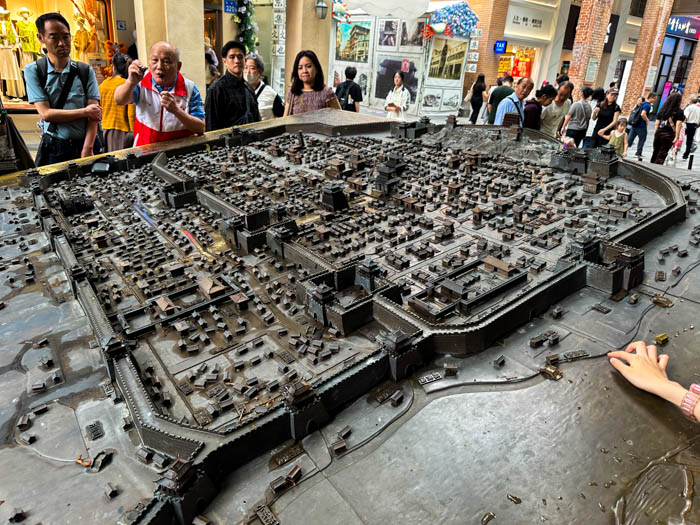
The Dali Ancient City is vast — far larger than expected — and remarkably intact.

The old city walls still stand, complete with imposing gates and watchtowers that once guarded the kingdom. Walking through them, you get a real sense of scale — this wasn’t just a town, it was a significant regional centre with both strategic and cultural importance.

Inside, the streets stretch out in a grid, lined with traditional Bai-style buildings, various shops, and a steady flow of visitors.

It’s busy — very much on the domestic tourist trail — but it doesn’t take much to step away from the main streets and find something quieter.

Turn a corner, wander down a side alley, and suddenly the noise fades. You’re back to slower moments — locals going about their day, small courtyards, glimpses of everyday life tucked just behind the busier facades.


Near the centre of the old town stands the Wuhua Tower.

At first glance, it feels like it should be part of the city’s defensive system — but it wasn’t.

Historically, Wuhua Tower dates back to the Nanzhao Kingdom (which preceded the Kingdom of Dali) and served more as a ceremonial and cultural structure than a military one. It was used as a place for gatherings, receptions, and entertainment — a symbol of prestige rather than protection.

What stands today is a reconstruction, but it still reflects that original purpose — positioned prominently, not for defence, but to be seen.

It’s a small detail, but it says a lot about the city: not everything here was built for war. Some of it was built simply for life, culture, and display.


Dali is full of contrasts.

Modern shops sit beside traditional homes. Tourist-heavy streets give way to quiet, almost untouched corners. Old stonework meets neon signs.

At times, it feels curated. At others, completely genuine.

But that blend is part of what makes it interesting.

It’s not frozen in time — it’s evolving — yet still holding onto enough of its past to remind you where it came from.

And like much of this journey, the more you wander, the more those layers begin to reveal themselves.


4. May 2026 11:05
by Rene Pallesen
0 Comments

China 2026 Yangshuo Impression Sanjie Liu

4. May 2026 11:05 by Rene Pallesen | 0 Comments

In the evening at Yangshuo we went to a show called "Impression Sanjie Liu". We had heard a lot abou
In the evening at Yangshuo we went to a show called "Impression Sanjie Liu". We had heard a lot about this show, so the expectations were high.

This is an open air show where they have converted a section of the river and limestone towers into a stage with hundreds of actors. This includes lots of bamboo rafts, boats and fabric strung across the entirety of the river.

It started out beautifully and very impressive.

I do wish that the end of the show had matched the beginning of the show in wow factor. I don't know how, but I do think they could have put more lights on the river and the limestone cliffs as this would have added to the finale.


Also, during the show there is a scene with a girl dancing on a crescent moon along with other dancers along the river. From a distance it looks like they are not wearing much at all (if anything). In town we did see a poster for the show and this seemed to confirm this...but you tell me.


2. May 2026 12:05
by Rene Pallesen
0 Comments

China 2026 Yangshuo

2. May 2026 12:05 by Rene Pallesen | 0 Comments


Leaving the intensity of Guangzhou behind, we boarded a high-speed train bound for Yangshuo — and in just a couple of hours, everything changed.

At times the train was pushing close to 300 km/h, yet inside it felt effortless. Smooth, quiet, almost disconnected from the speed. It was a fitting transition — from megacity to countryside in what felt like no time at all.

And the first thing we noticed stepping off the train? The air.

It was like perfume. The surrounding trees were in full bloom, and after the density of Guangzhou, it felt fresh, almost surreal — like we’d stepped into a completely different world.


Waiting for us in Yangshuo were familiar faces — Sacha, Mavis, and their daughter Sammi. From here on, the trip shifted. It wasn’t just the four of us navigating something new anymore.


Yangshuo is famous for its karst landscape — those dramatic limestone peaks that rise almost vertically from the ground, scattered across rice fields and rivers like something out of a painting.

The best way to experience it is simply to get out into it.

So that’s what we did.

Everyone grabbed bikes — except for Kim and me, who opted for an electric scooter (a wise decision, given the distances and the terrain). With Kim on the back, we set off, following winding roads out of town and into the countryside.

It didn’t take long before we got lost. But in Yangshuo, that’s kind of the point.

We drifted through small villages, along narrow paths, and eventually found ourselves surrounded by rice paddies and towering limestone stacks in every direction. The scenery didn’t feel real — it felt too perfectly composed, like a traditional Chinese landscape painting brought to life.

At one point, we hit complete gridlock in a village — cars, scooters, pedestrians, all tangled together in a standstill. What should have taken minutes stretched out endlessly as we tried to push through.

Thankfully, being on bikes worked in our favour. Slowly, carefully, we squeezed through gaps that cars simply couldn’t.

The kids handled it brilliantly. It was a long day, and at times the traffic got chaotic, but they rode with confidence — listening, adapting, and just getting on with it.

There was one moment of tension when Mavis was nudged over by a car in the congestion, but thankfully she came away shaken more than anything else.


Somewhere along the ride, as we moved between villages and open countryside, we passed something that made us slow down.

An elderly man — well into his eighties — sitting quietly outside his home, weaving hats by hand.

There was nothing staged about it. No performance, no attempt to attract attention. Just a simple, repetitive motion, practiced over decades. His hands moved with a rhythm that didn’t need thinking — strip by strip, shaping something both practical and beautiful.

We stopped for a while, watching.

In a place where so much is changing so quickly — high-speed trains, digital payments, modern cities rising almost overnight — this felt like a direct connection to something much older. A way of life that hasn’t entirely disappeared, but is slowly becoming harder to find.

There was a calmness to it.

No rush, no urgency — just time, skill, and patience. The kind of work that carries quiet pride, even if it goes largely unnoticed.

For us, it was a reminder that not everything moves at the same pace.

And in that brief stop, somewhere between getting lost and finding our way again, we found one of the most genuine moments of the journey.


Next day it was a short trip out to Xingping that brought one of the most recognisable scenes of the trip.

Just outside the town lies a bend in the Li River that’s instantly familiar — even if you don’t realise it at first. It’s the exact landscape printed on the back of the Chinese 20 Yuan note.

And once you see it, it clicks.

The same karst peaks, the same river curve — a view that’s been quietly circulating in millions of wallets for years.

What followed was a surprisingly fun challenge: trying to line up the real view with the image on the note.

There were people everywhere doing the same thing — holding up old 20 Yuan notes, adjusting angles, laughing as they tried to get the perfect match.

The irony wasn’t lost on us.

China today is almost entirely cashless. Paying with a phone is the norm, and physical money feels like a relic. We didn’t even have a note ourselves — we had to borrow one just to take part.

Also lined up along the river were rafts, cormorant birds and people dressed up with hired photographers to have their photo taken.


Down by the river, near one of the many low bridges crossing the water, we climbed onto a bamboo raft and set off along the Yulong River.

Although this would have been Yangshuo at its most peaceful, it was packed with other rafts, hot air balloons and motorised paragliders.

Once we got going the raft glided quietly upstream, the only sounds being the water and the occasional call from the riverbanks. Limestone peaks rose on either side, softened by mist and distance, while reflections shimmered gently below.

On the way back down, everything felt even more relaxed. No rush, no noise — just drifting through one of the most iconic landscapes in China.


As the sun dropped behind the karst peaks, we made our way back into town and joined the evening flow along West Street.

If the countryside had been calm and open, this was the opposite.

West Street comes alive at night. Lights spill out from shops and restaurants, music drifts through the air, and the narrow street fills with a mix of locals, travellers, and everything in between. It’s lively, a little chaotic, and full of energy.

We wandered without much of a plan — stopping to look at small food stalls, peeking into restaurants, watching musical performers, and just taking it all in. There’s a blend here that feels uniquely Yangshuo: traditional elements sitting right alongside modern tourism, local life mixing with visitors from all over.

For the kids, it was sensory overload in the best way — noise, lights, movement everywhere. For us, it was a chance to just observe. The rhythm of the place, the interactions, the small moments happening all around.

After a day of riding through villages and open landscapes, being back in the middle of it all felt almost surreal.

Yangshuo has that balance — peaceful by day, vibrant by night.

And West Street is where those two worlds meet.


angshuo will be remembered for its landscapes — the limestone peaks, the rivers, the countryside that feels almost unreal.

But for me, that’s not what lingers.

As much as the scenery impresses, it’s the people who stay with you.

The old man weaving hats outside his home. The quiet glances in the alleyways. The locals going about their day, completely untouched by the fact that, for us, this was something extraordinary. Even along the busy stretch of West Street, behind the lights and movement, there were still those moments — brief, unspoken connections with strangers.

As a photographer, that’s what draws me in. Not just the image, but the story behind it. The history carried in a face, the traces of a life lived in a place that’s changing faster than most.

Landscapes can be breathtaking, but they don’t look back at you.

People do.

And in those fleeting moments — a glance, a smile, a moment of curiosity — there’s something real. Something that cuts through language and culture.

That’s what I’ll remember most about Yangshuo.

Not just where we went… but who we encountered along the way.


24. April 2026 16:04
by Rene Pallesen
0 Comments

China 2026 Guangzhou

24. April 2026 16:04 by Rene Pallesen | 0 Comments

First Shamian Island in GuangzhouThen sight seeingDinner with one of Kims friends at exclusive priva
Guangzhou was our gateway into China — just the four of us: Rene, Kim, Aiden and Lucas.

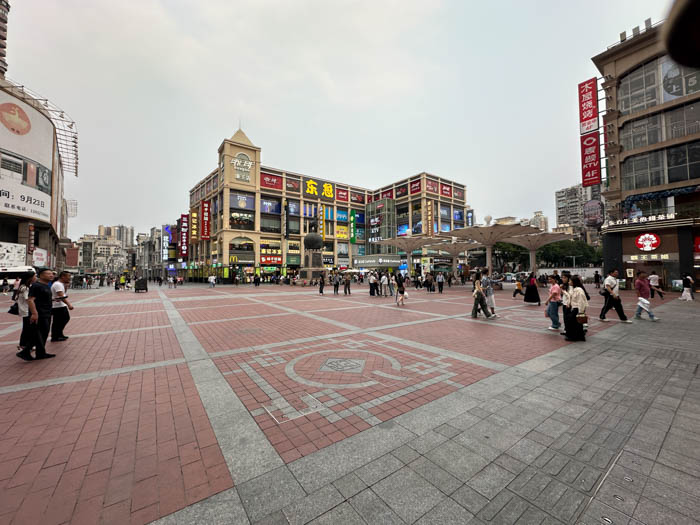
Arriving into Guangzhou, the sheer size hits you first. This isn’t just a big city — it’s a sprawling megacity built on more than 2,000 years of history, now layered with relentless modern growth. Yet it is super clean everywhere and despite all the traffic it is super quiet due to everyone driving electric bikes and cars.

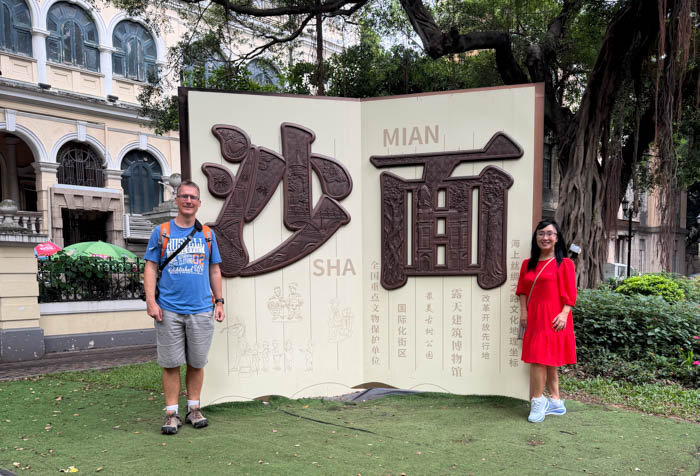
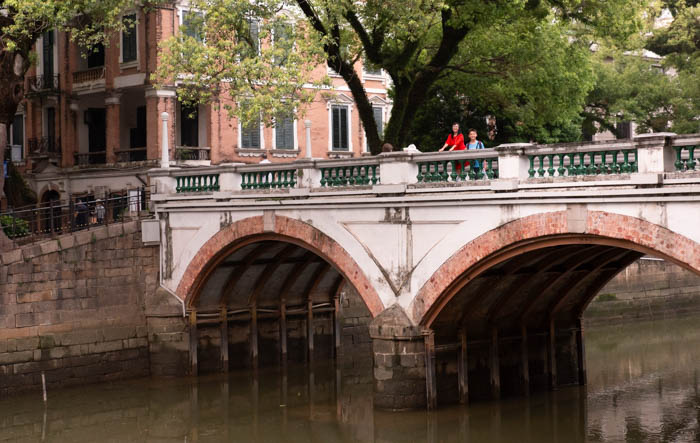
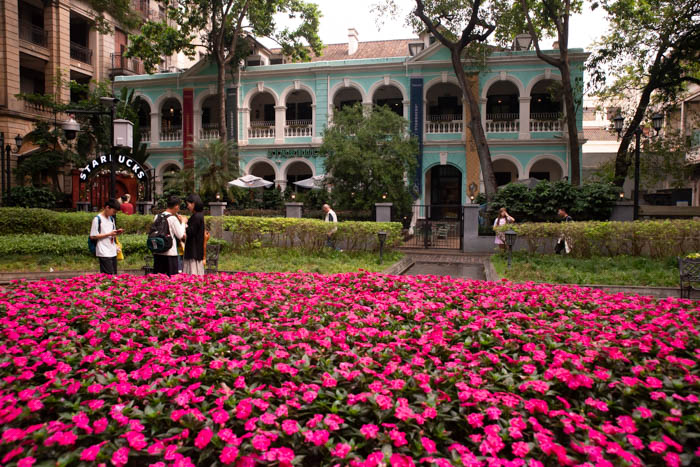
First stop in the morning was Shamian Island. Walking onto Shamian Island feels like stepping into Europe. Tree-lined streets, colonial mansions, quiet cafés — it couldn’t be more different from the rest of the city.

But this place carries a complicated history. After the Opium Wars in the 19th century, this small island was carved out and divided between British and French control, becoming a foreign enclave in China.

What remains today is a fascinating blend of cultures — European architecture, Chinese life, and a sense of calm that feels almost surreal in a city like this.

For us, it was one of those rare travel moments where everything slows down. The boys could wander, Kim could soak in the atmosphere, and I found myself drawn to the history that I have read about in numerous books.
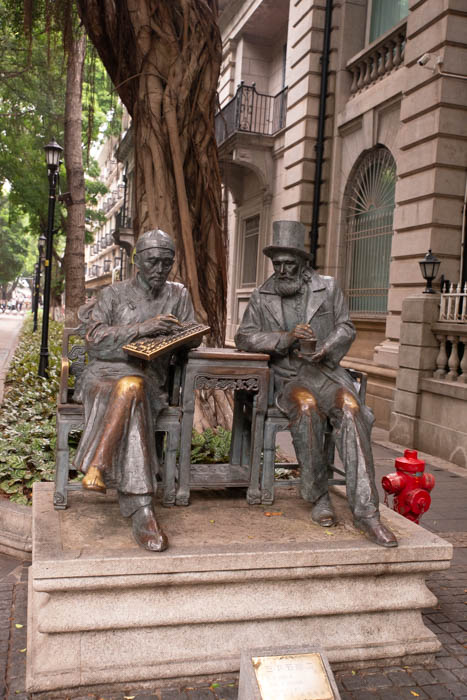
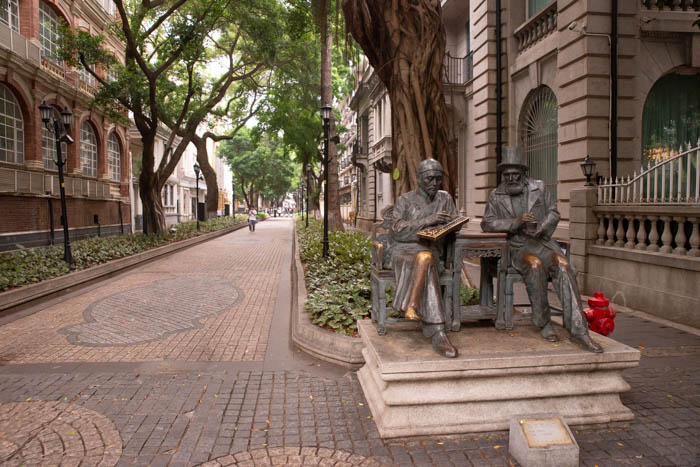
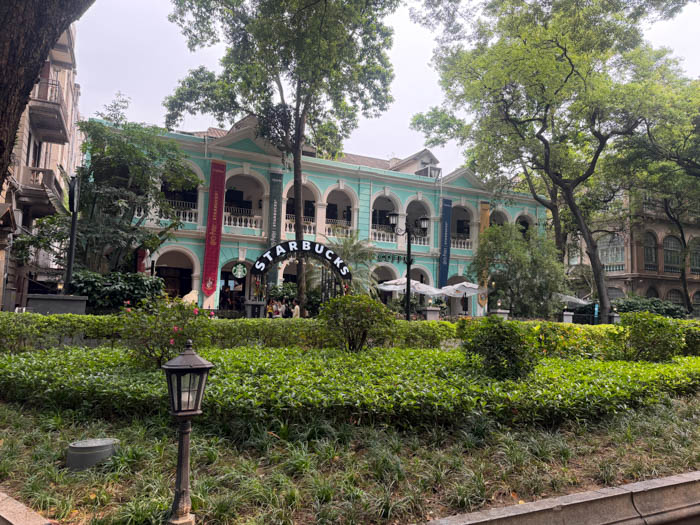
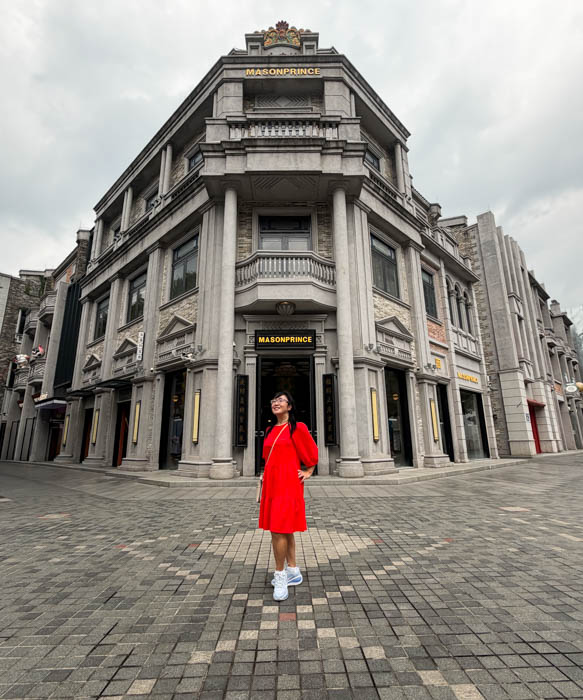
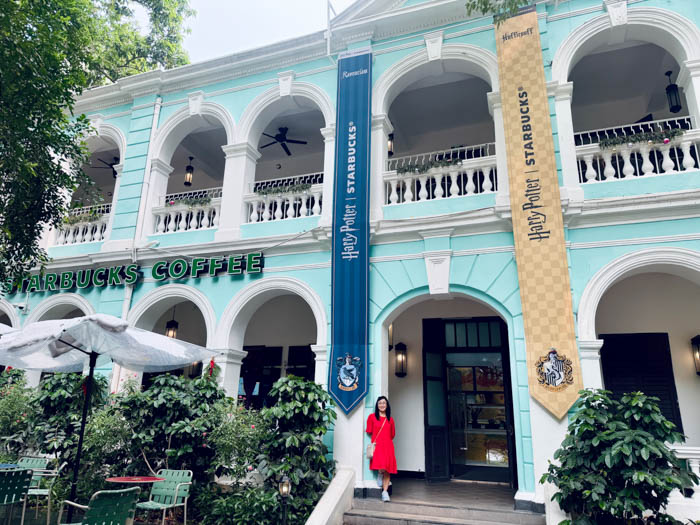
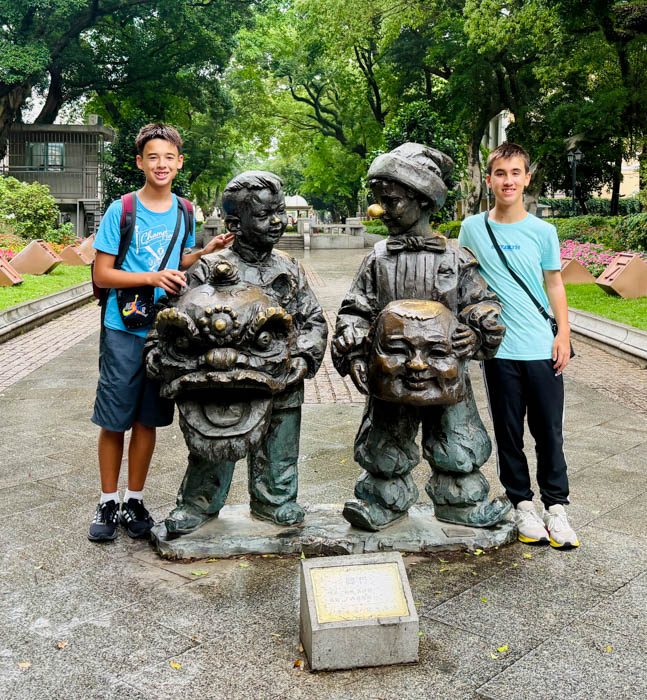
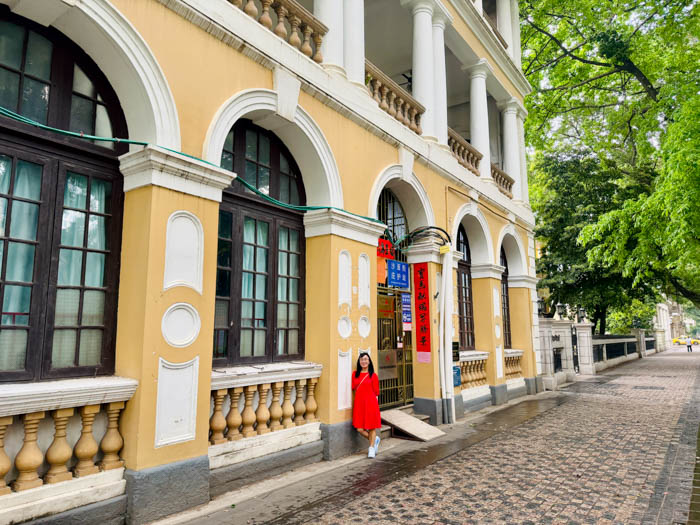


It’s easy to be distracted by Guangzhou’s scale — the towers, the traffic, the constant movement — but the real character of the city reveals itself when you step off the main roads and into the narrow alleyways.

These laneways are where life compresses.

The streets tighten, the noise softens into something more human, and suddenly you’re walking through someone’s everyday world. Open doorways reveal small kitchens in full swing, laundry hangs overhead like a patchwork sky, and scooters squeeze past with barely enough room to spare.

This is where Guangzhou slows down.

We wandered without much of a plan, turning corners simply because they looked interesting. The boys quickly realised this was a different kind of exploring — not landmarks, but observation. Small moments. A nod from a local, a curious glance, someone going about their day completely unfazed by four outsiders passing through.

For me, this was where the camera came alive. Not because of anything grand, but because of the texture — worn walls, layered history, faces that told stories without words.
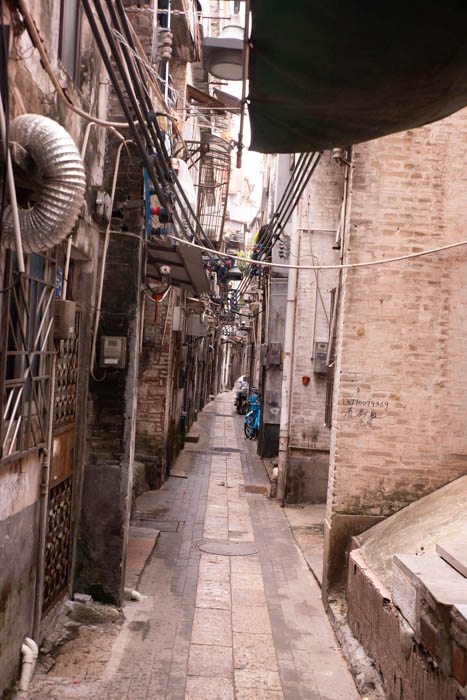
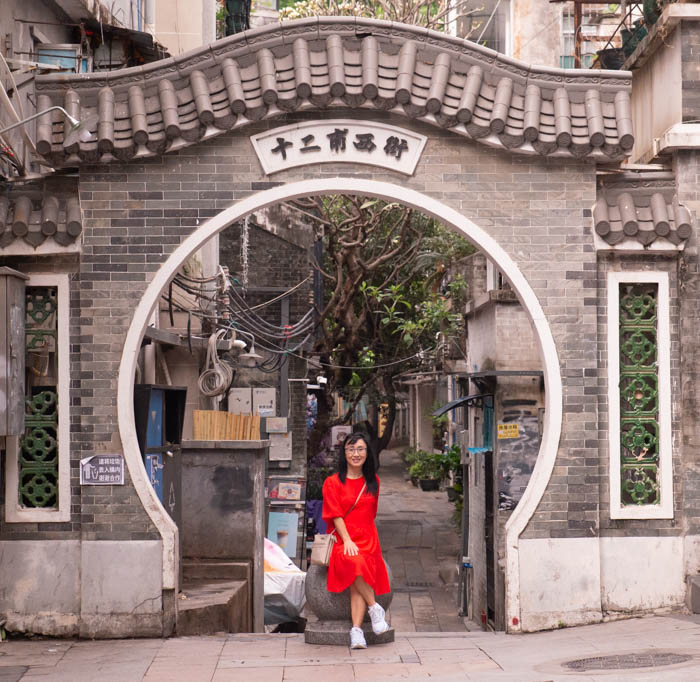


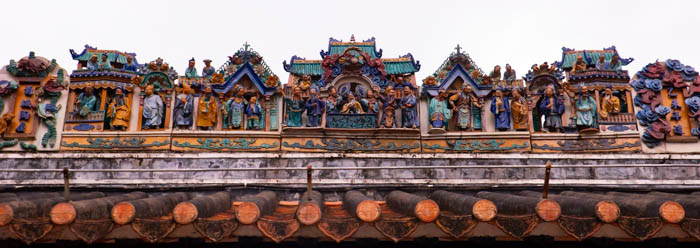
Not far from the bustle of the city, we found ourselves wandering into the area around the Guangdong Cantonese Opera Museum — and it turned out to be one of the most unexpectedly fascinating parts of Guangzhou.

The museum itself is beautifully designed, built in the style of traditional Lingnan architecture, with ornate roofs, carved woodwork, and peaceful courtyards. But what really drew us in wasn’t just the building — it was what was happening around it.

Locals were gathering, dressed in elaborate Cantonese opera costumes — vibrant silks, intricate embroidery, and dramatic makeup. Some were performers, others simply enthusiasts, but all of them carried a quiet pride in what they were part of.

What made it so compelling was how natural it all felt.

People were chatting, adjusting costumes, helping each other prepare, and taking photos — not for tourists, but for themselves. It wasn’t staged or curated. It was a living tradition, still very much part of everyday culture.

Cantonese opera has deep roots in southern China, blending music, storytelling, martial arts, and symbolism into a highly stylised art form that dates back hundreds of years. And here, in this small pocket of Guangzhou, it wasn’t something preserved behind glass — it was still alive.
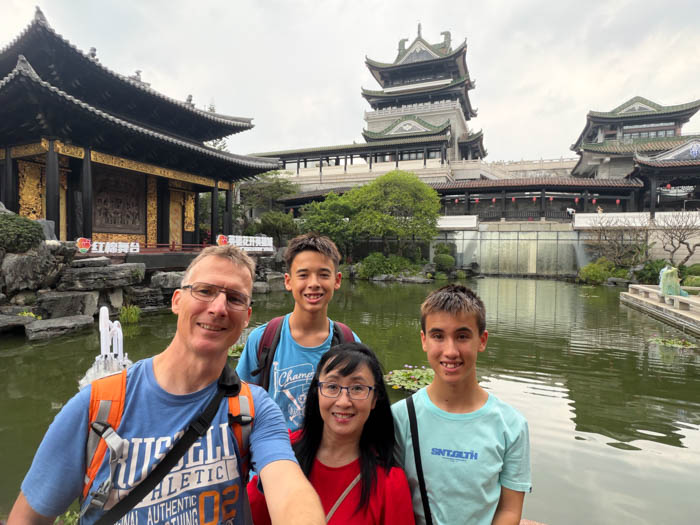
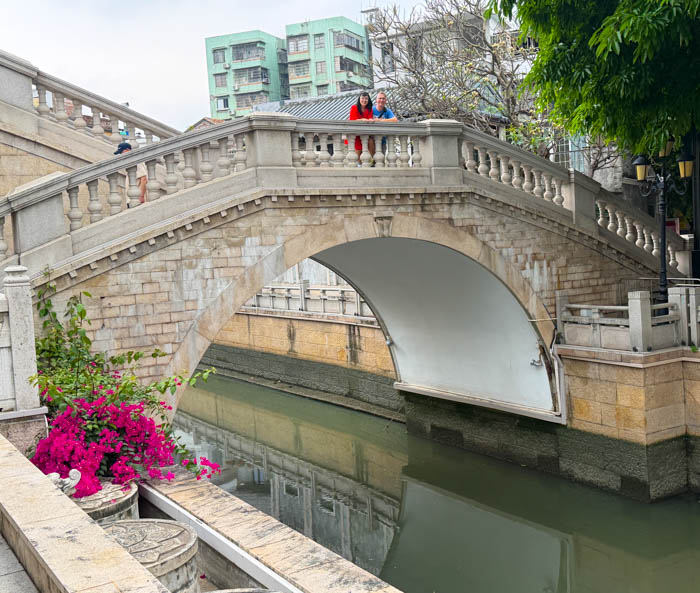


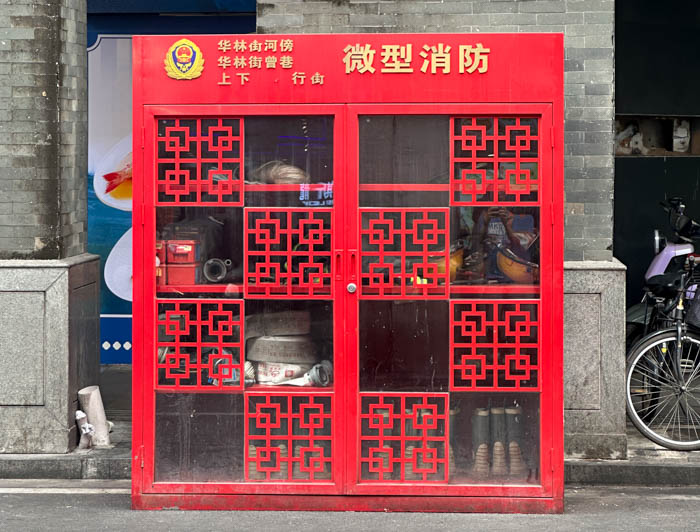
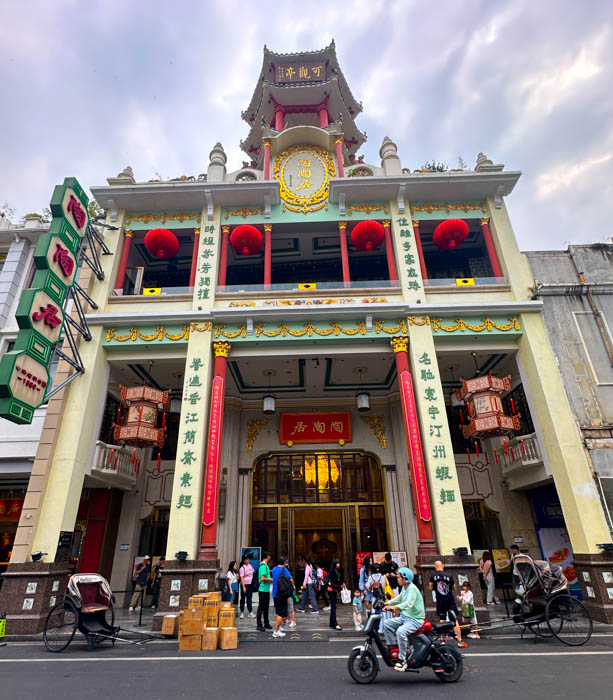
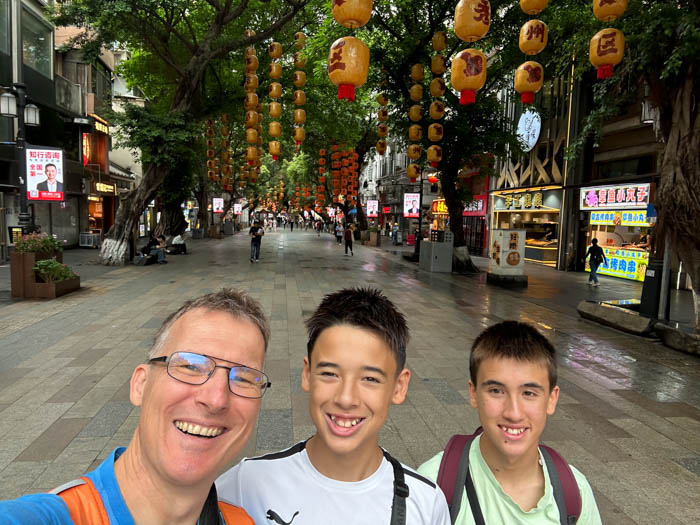
Beyond the main roads, the city unfolds through a rhythm of small shops and daily rituals. Narrow storefronts spill out onto the pavement — fruit stacked in careful pyramids, hardware stores packed floor to ceiling, tiny eateries with a handful of stools and a constant flow of regulars. There’s no clear boundary between business and street; everything blends together into one continuous, living space.


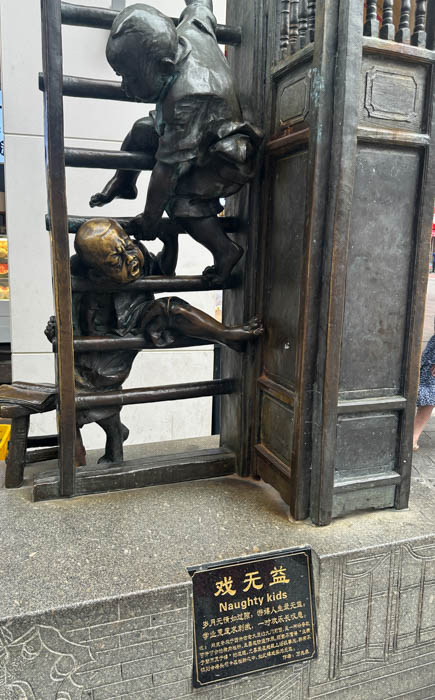
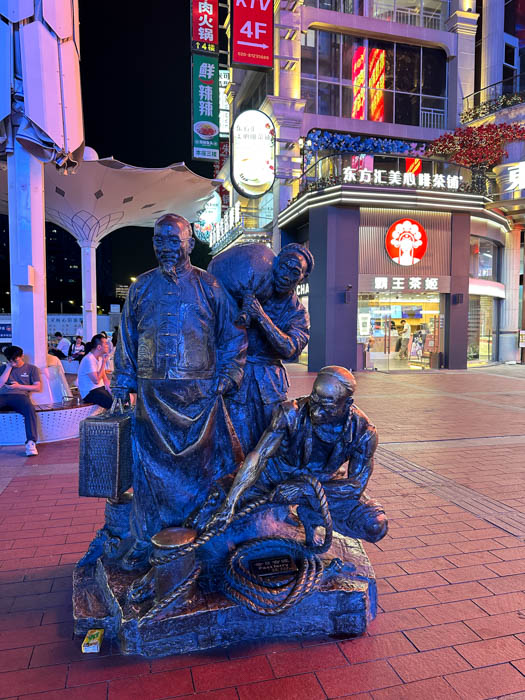
And then, almost quietly, you start to notice them — the bronze statues.

They’re scattered throughout the city, often without fanfare. A fisherman hauling in a net. A street vendor mid-sale. Children playing. Scenes from another time, frozen in metal but placed right in the middle of modern Guangzhou.

They’re easy to walk past if you’re not paying attention.

But once you notice them, they change the way you see the city.

These aren’t grand monuments to emperors or victories — they’re tributes to everyday life. They reflect the trading roots of Guangzhou, once one of China’s most important ports and the starting point of the Maritime Silk Road. For centuries, this was a city defined by commerce, movement, and connection to the outside world.

And those stories are still here — just told in quieter ways.


One evening in Guangzhou took a different turn.

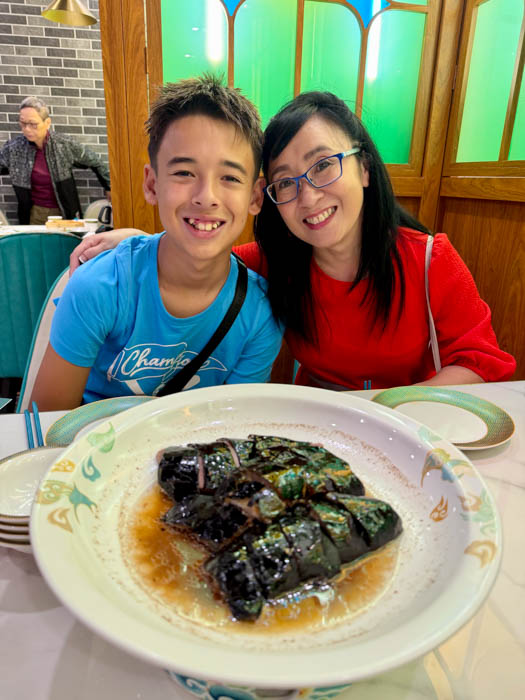
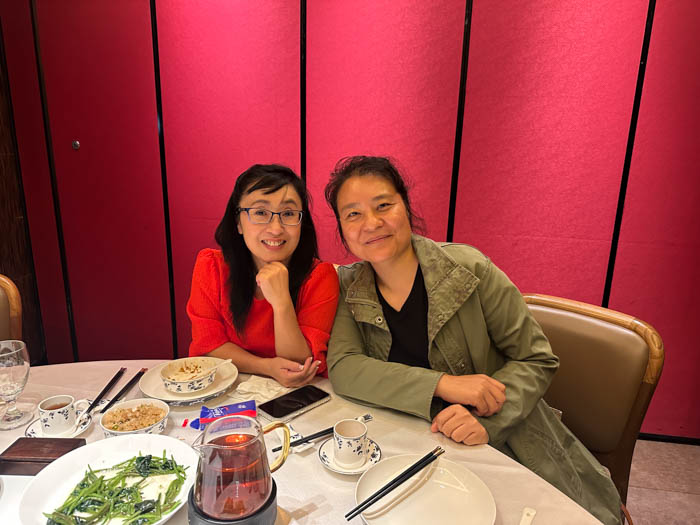
Kim had arranged to meet an old colleague, and instead of the street-side eateries and small local restaurants we’d been exploring, we were taken somewhere altogether more elaborate.

From the outside, it didn’t immediately give much away. But once inside, the scale revealed itself.

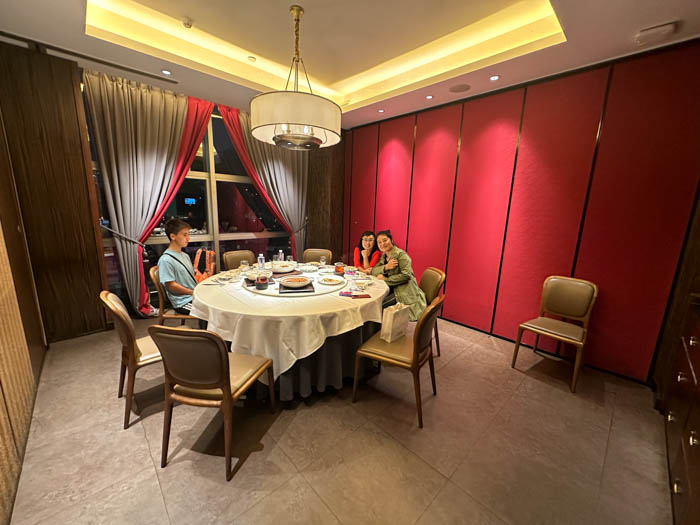
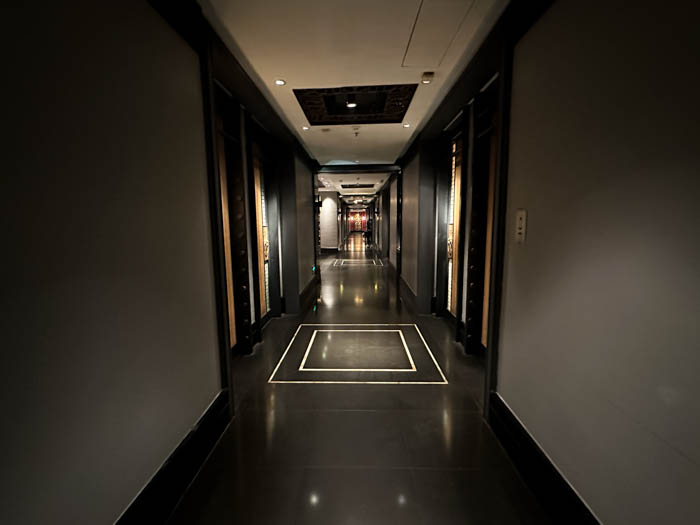
The restaurant unfolded like a maze — long corridors branching into more corridors, each lined with private dining rooms hidden behind heavy doors. It felt less like a restaurant and more like a series of discreet, self-contained worlds. Every group tucked away in their own space, out of sight, out of earshot.

You couldn’t help but wonder what kinds of conversations these rooms had hosted over time. Business deals, family negotiations, celebrations, quiet discussions — the kind of interactions that are never meant to spill into the public space.

There’s a long tradition of private dining in China, especially in cities like Guangzhou where relationships — guanxi — are central to both business and social life. Meals aren’t just about food; they’re about trust, hierarchy, and connection. And spaces like this are designed for exactly that.

For us, it felt like stepping briefly into that world.

The food itself was exceptional — beautifully presented, carefully paced, and clearly designed to impress. But interestingly, it wasn’t the local Cantonese street-style cuisine we’d been expecting. This was something more refined, more international in influence, almost curated to suit a different kind of audience.

For the boys, the novelty was in the setting — their own private room, the formality of it all. For Kim, it was a chance to reconnect. And for me, it was the atmosphere that lingered — the sense that behind every closed door, a different story was unfolding.

It was a completely different side of Guangzhou.

Not the chaotic, open, street-level city we’d come to know — but something quieter, more controlled, and in its own way, just as revealing.


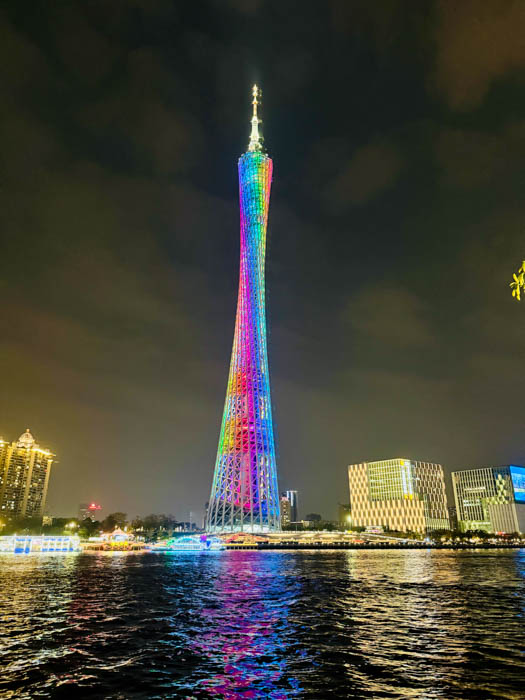
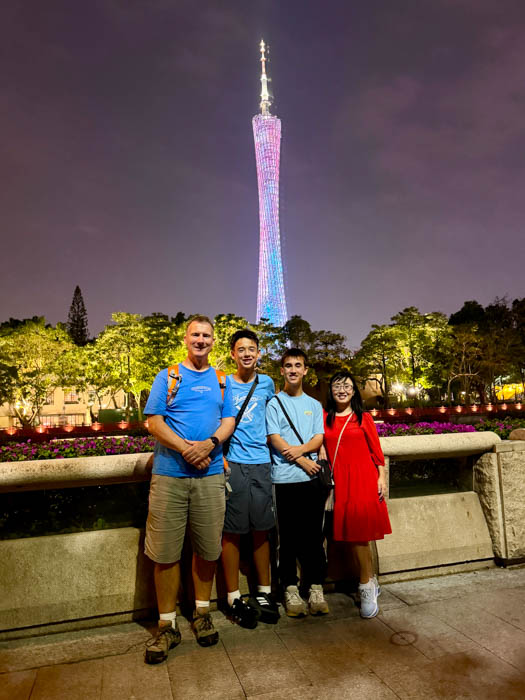
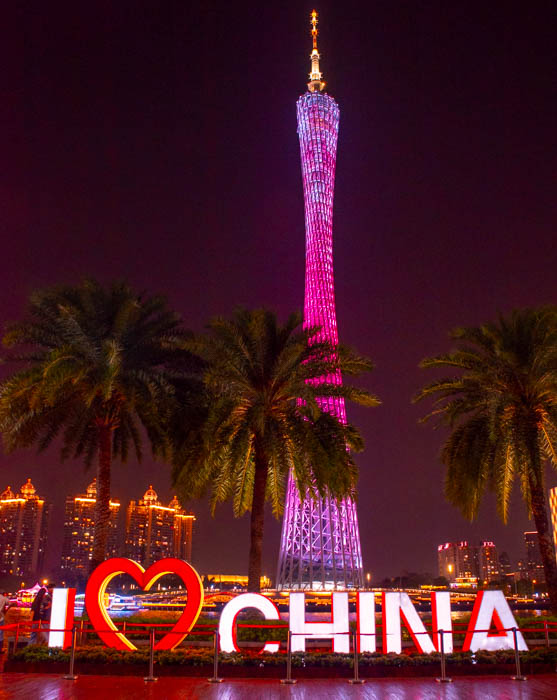
After dinner, we stepped back out into the night and made our way down to the river, drawn by the glow of the Canton Tower rising in the distance.

If the restaurant had felt enclosed and hidden, this was the complete opposite.

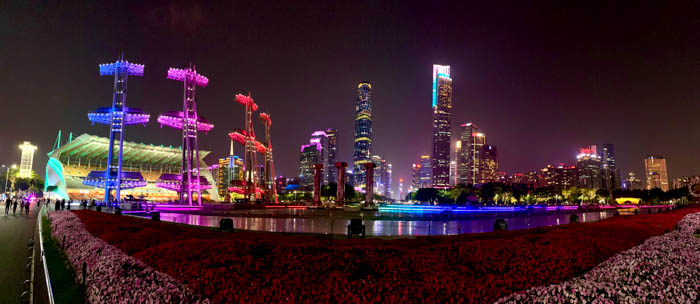
The Pearl River opens everything up. Wide promenades, open air, and a steady flow of people out enjoying the evening — families, couples, groups of friends, all moving at a slower, more relaxed pace than the daytime rush.

And then there’s the tower.

Up close, the Canton Tower doesn’t just dominate the skyline — it feels almost unreal. Its twisting structure is lit in shifting colours, constantly changing, reflecting off the river below. Boats drift past, their own lights adding to the scene, and the whole area takes on a slightly surreal, almost cinematic feel.

The boys were immediately drawn to the energy of it — the lights, the movement, the scale. For them, this was Guangzhou at its most exciting.

The Pearl River has been the lifeblood of Guangzhou for centuries — the reason the city became one of China’s most important trading ports, connecting it to the outside world long before the skyscrapers arrived.

Now, instead of trading ships, it’s light shows and river cruises.


Somewhere in the middle of Guangzhou’s busy streets, we stumbled across something completely unexpected — and for Lucas, it may well have been the highlight of the entire city.

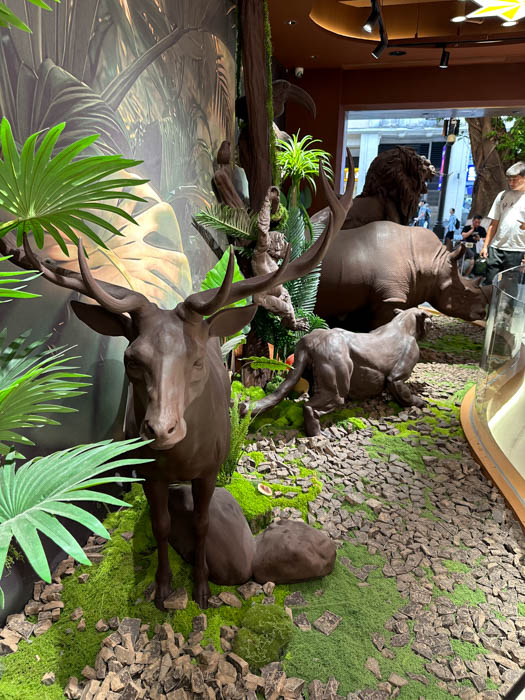
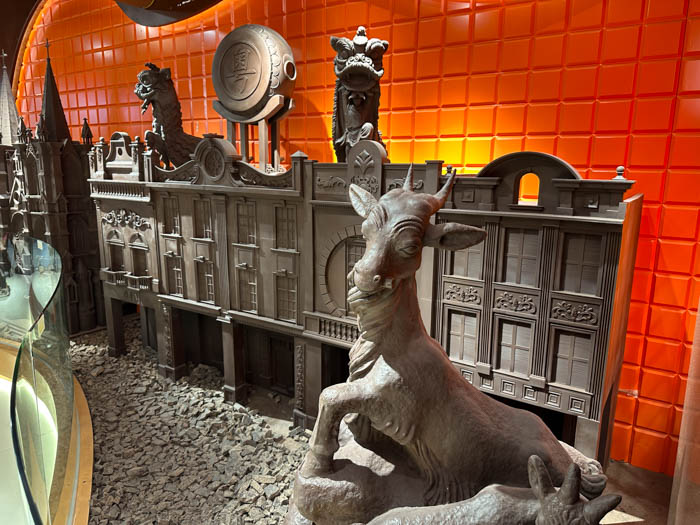
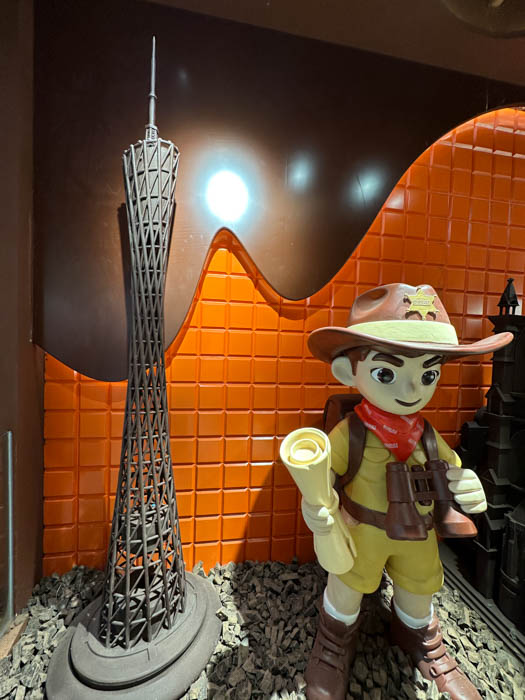
A shop where everything looked like it belonged in a museum… but was made entirely of chocolate.

Not just small displays or decorative pieces, but full-scale creations. Life-sized animals stood frozen mid-step — elephants, giraffes, creatures you’d expect to find on the African savannah, not in a shop in southern China. Alongside them were intricate replicas of local architecture, temples and buildings recreated in astonishing detail, all in chocolate.

At first, it didn’t quite register. The level of craftsmanship made it hard to believe it wasn’t carved wood or painted resin. But the closer you looked, the more surreal it became — every surface, every texture, every tiny detail… chocolate.

Lucas was completely in his element.

You could see the internal conflict playing out — admiration versus appetite. Was this something to photograph, or something to eat? (The answer, unfortunately, was mostly the former.)



5. February 2026 16:02
by Rene Pallesen
0 Comments

Cook Islands - Long Boat

5. February 2026 16:02 by Rene Pallesen | 0 Comments

On a rainy afternoon we went in a longboat. The idiot at the back almost got all of us killed by hav
On a rainy afternoon we went in a longboat. The idiot at the back almost got all of us killed by having no idea how to steer (that was his one job) and landed us on the outer reef.


5. February 2026 16:02
by Rene Pallesen
0 Comments

Cook Islands - Snorkeling

5. February 2026 16:02 by Rene Pallesen | 0 Comments

We went snorkeling in the lagoon


5. February 2026 16:02
by Rene Pallesen
0 Comments

Cook Islands - Boys at Black Rock Beach

5. February 2026 16:02 by Rene Pallesen | 0 Comments

I also took some photos of the boys at Black Rock Beach.


5. February 2026 16:02
by Rene Pallesen
0 Comments

Cook Island - Turtles

5. February 2026 16:02 by Rene Pallesen | 0 Comments

One day we went snorkeling with the turtles in the lagoon.


Perfect Moments Photography | A Rene Pallesen Journal

Home

22. March 2008 06:08
by Rene Pallesen
0 Comments

Rio De Janeiro - Brasil

22. March 2008 06:08 by Rene Pallesen | 0 Comments

rio de janeiro brasil


We are now in Brasil after an overnight stopover in Santiago (The flights here in South America are fairly irregular so it can be difficult to get connecting flights without having stopovers).

We hadn't booked a place to stay but at the airport the tourist information suggested renting an apartment at Ipanema. When we got there it turned out to be really basic, fairly prices and probably a friend of the guy at the tourist information. Instead we went to Copacabana beach to one of the other options we had which also was very basic and a bit far from the beach...but at least non commiting for more than one night. Later in the evening we walked around and eventually found a hotel close to the beach and cheap. It also had big mirrors on the wall and in the ceiling over the bed...and Kim and I was wondering if it was one of those hotels that could be hired by the hour.
It did however turn out to be really nice apart from one evening when some of the other guests tried to get into our room because they got the number on the door wrong.

The day after we went to Ipanema beach to go for a walk. It is very beautiful in Rio and especially this beach is really cool.

Click here for more photos

After lunch we took the local bus to the Sugarloaf mountain. Traffic is really bad in Rio and Taxis are outrageously expensive and just as slow as the busses so it took us about two hours to get there. It turned out to be perfect. We ended up taking the lift of there just before sunset and had a fantastic view from the top.

Click here for more photos

Click here for more photos

Click here for more photos


Click here for more photos

In the evening we had a fantastic meal called a Ridozio (or something like that). It was a 15 course meal (A lot more than we could eat) and only cost around 10 australian.

Next day we decided to go to see the Jesus statue first thing in the morning. Again we took the local bus there to save some money (Rio is really expensive). We then took the train up to the Statue which has got a fantastic view of Rio and all the beaches.

Click here for more photos Click here to see more photos

Click here for more photos

On this trip with Kim I had planning to ask her if she'd marry me. I had three possibly locations in mind..29th Feb in Santiago, Machu Picchu or at the statue in Rio. Kim was very happy when I popped the question and showed her the ring I'd gotten for her (but more about that later), so we are officially no longer boyfriend and girlfriend.

Click here for more photos

Click here for more photos


In the evening we went to a restaurant called Porcao Rios which had been recommended to be by our partner in Mexico to celebrate and later we had a drink down at the beach.

Click here for more photos

We didn't get back to the hotel until very late and I promised that I would never again walk back to the hotel that late at night. There were people from the slums everywhere and I didn't feel safe walking back...so next time we definitely take a taxi. In the daytime you see quite a few police cars and police officers around...but at night they are very hard to spot. It is almost like the movie 'I am Legend'...you are safe during the day, but as soon as night falls and most people have gone off the streets then the kids from the slums rule the city. It is truly a dangerous place at night...not that we were carrying any valuable on us whatsoever except for whatever cash we needed on the night, but the question is....would these kids believe that that was all we were carrying?
All houses an properties in the more wealthy areas are all surrounded by big fences and cages to keep the kids out...but really...not a very comforting way to live if you cant leave your house.

Another thing I noticed is that there also still is a class difference between the white/light and the black. The blacks have all the lowest paid jobs and the ones requiring manual labour. It is also the black people you see living on the street and going through the garbage every night (and there are a lot of these). So even through slavery was abolished several hundred years ago doesn't mean that everyone is equal.

In the morning I had caught some sort of a stomach bug...probably from the one drink I had at the beach and was feeling really weak so we spend the day doing a bit of shopping locally and then went to Ipanema.

Click here for more photos

Click here to see more photos

In the evening I started to feel really weak and felt like vomiting so dinner consisted of some light vegetables followed by coca cola (The ultimate remedy for any stomach problems).


Last day we slept in (ignored the hotel checkout time) and packed out stuff. I still felt a bit weak but otherwise ok (My bug lasted for two days after which I felt really weak but a dose of Imodium eventually took care of it).

Next back to Santiago overnight and then back to Sydney

Click here to see more photos from Brasil

14. March 2008 10:23
by Rene Pallesen
0 Comments

Sucre - Bolivia

14. March 2008 10:23 by Rene Pallesen | 0 Comments

sucre bolivia


Wow, wow, wow...Sucre is everything that La Paz isn´t...it is fantastic.

Click here to see more photos

We took the bus from Potosi yesterday afternoon and drive through a fantastic landscape of deep canyons and high mountains and through passes of 4800 meters altitude. As soon as we arrived into Sucre we fell in love with it. Right from the start at the bus terminal they had fixed prices on taxis. We drove into town with an old gentleman that had a 1970´s Datsun.
He held the door for us at the hoteland made sure we had accomodation.

Oh..yeah...did I mention accomodation. Kim had booked the Hotel Real Audencia the night before and received confiemation. When we got to the Hotel they didn´t have our booking but fortunately the hotel is empty (I think we are the only ones here). They told us that it was $60 per night...Kim said that the booking we had was $45 and they agreed to this price. It later turned out that she by mistake had booked the Real Audencia in Quito Equador 2000km from here...LOL.
Anyway the hotel is fantastic and Kim loves the luxery...not even Hilton compares and it is 1/20th of the price of a similar hotel.

Click here for more photos

Click here for more photos

We then went to this French restaurant La Taverne...fantastic. I spoiled Kim with a 5 star meal that we would have a hard time finding in sydney...price for the two of us...less than $10.

Sucre is a nice and quiet city...it is beautiful with all the old colonial white washed buildings and it is clean and not polluted. There are far less beggers and street kids and far less social problems. Everything is getting very well maintained and it is a really romantic place to walk around at night through the plazas...with people everywhere at night.

Click here for more photos

We were initially planning to go back to Santiago one day early...but because this is such a nice place we stay here another night and then spend as little time as possible in La Paz. We also treat ourselves to a flight to La Paz which takes 45 minutes rather than a terrible 14 hour bus ride.

Sucre is at 2800 meters altitude but probably 20 degrees warmer than Potosi (4000-4500 meters). It is so nice being able to walk around in a T-Shirt during the day and just a thin Alpaca (I´ve bought two for less than $15 each)jumper during the night.

We went out to the dinosaur park. In some limestone they have found some 5000 tracks from more than 400 different species of dinosaurs. The park has only been open for less than two years and will be a major attraction once they get the place conserved and once the word spreads.

Click here for more photos

We also had lunch at this fantasic Cafe Mirador overlooking the whole city...very nice.

Next day we hired a guide to take us through one of the local Inca trails as well as to a small village called Potola. It was raining so in the beginning it was pretty cold and miserable but eventually it stopped and we had a really nice day on the Inka trail (by the way there are thousands of Inka Trails around the Andes...most of them still in use by the locals as the main mode of transport still is on foot).

Click here for more photos

Potola is a small village west of Sucre. It is supposed to have a lot of local still dressed in their local costumes and lost of local handicraft...but really is has none of that. There was far more dressed in local costumes in Copacabana.

Click here for more photos

As such for Bolivia it has got a huge potential for developing tourism...but the people there don't understand how to do it.

Tomorrow...onto Santiago and then continue to Rio De Janeiro

Click here to see more photos from Bolivia

12. March 2008 11:54
by Rene Pallesen
0 Comments

Potosi, The Mines - Bolivia

12. March 2008 11:54 by Rene Pallesen | 0 Comments

potosi the mines bolivia


Today was a really positive day compared to yesterday after I'd written my last post. We found an excellent restaurant (much better than most restaurants in Sydney) called El Meson...and the food was cheap as. For around USD 13 we got a three course dinner that was absolutely fantastic including drinks. It was so good that we decided to go back there tonight.

This morning we had to move hotel. We did try to extend one night at Hotel Eldorado...but everything in this town is fully booked. Late last night we had managed to put through a couple of bookings at other places, but the only one that came through was a local hostel...so this morning we moved there. It is a nice enough place...but the personnel is totally disinterested in providing a service (and no smiling please)...there is no heat in the room so it could be a cold night...but everything else is ok once you chase them for towels, blankets etc.
The told us that we couldn't have the room until 11.30am...so in the mean time we decided to go to the mint museum.

The Mint museum was really good. They had a lot of interesting items there and they provided an english speaking guide for free to explain how the silver was mined in Potosi, the historical significance as well as went through the whole process of producing silver coins which were produced in the same building (All the original equipment is still there). They also have a fantastic art collection there.
We joined the guided tour a bit late, but the guide was kind enough to repeat the first part of the collection so that we didn't miss out.

The highlight for Kim was when I made her a copper coin using an original minting stamp using a large hammer...she got to keep the coin as a souvernir.

After a lunch at La Plata (With the thickest hit chocolate we've ever seen...the spoon could stand upright) we went down to join a tour of the mines in Potosi. It turned out that Kim and I were the only ones on the tour and the guide spoke perfect English.

First we were fitted with overalls and helmets and afterwards the tour went to the miners market. I bought a stick of dynamite for around 5 Bolivianos (75 cents) and our guide gave Kim a fright when he threw the stick at her.

Click here for more photos Click here for more photos

Click here for more photos


After this we went to the processing plant where they do the first extraction of the metals from the rock. We saw how they crush the rock into a fine powder and then using various chemicals extract the metals from the rock as well as using gravity. All the chemicals and side products are then flushed into the Rio Negra where it then is washed into Paraguay and Argentina. Both BHP and Rio Tinto buy minerals from here processed in this way (It it great to see my shares at work). There are 42 such processing plans here in Potosi...because everything is working as coorporatives there is no investing in processing plants and machinery and the various plants refuse to work together although this would benefit everyone...but more about that later.

Click here for more photos

Afterwards we drove up to the mine itself. We expected to be visiting a part of the mine that was no longer being used but this is not the case...the mine was fully functioning so once in a while we had to run for our lives to a location where the tunnel was wide enough for us to jump to the side when one of the small trains came zooming past.

Click here for more photos

As we went further and further into the tunnels the gasses became thicker and thicker. I have never seen so many visible minerals in one location before...you could actually see the zinc, lead, copper, iron and bronce in the walls all over the place. The yellow sulphur was sitting in 2cm thick layers on the wall (but they don't mine this) and there was Albestos hanging in long threads off the ceiling all over the place and the air was think of asbestos dust.

Click here for more photos Click here for more photos


We were covering our mouthes with bandannas but running through the tunnels, the cramped places, the dust and the gasses in the air made it really hard to breathe through the bandanna (Remember that this is all happening at 4500 meters altitude where there is only 25% of the oxygen as at sea level...so there is not much air in the first place!). The miners themselves were chewing coca leaves to tolerate the gasses.


Click here for more photos Click here for more photos


Normally I would be fine, but at one point I thought I'd die and decided to not use the bandanna (I'd rather die young than die instantly)...and at this point we were still only on the first level (3 additional levels and appx 80 meters below us).

Click here for more photos


We got to a 20 meter almost vertical tunnel and halfway down we took a break where we got the chance to ask a lot of questions about the mine. We also asked if the gasses became worse than here and the reply was yes. We were also told that the tunnels were very similar so Kim and I decided that we'd had enough and would like to breathe clean air...also because the mines are still working and a lot of the supporting structures are from the colonial spanish times 350 years ago the mines are really dangerous places.

Click here for more photos

On the way out we say how the used an old electric motor to pull up the rocks from 80 meters below to our level and then dump it onto the trains. They actually have a champer above the level and then use a big hole in the floor to fill the trains...unsuspecting I walked across the pile 2 minutes prior to them opening up the while whereafter a 1 meter whole appeared in the floor.

Click here for more photos

The whole mountain has got more than 700 mines most existing several hundred years where more than 400 of them are in use today. There is no backfilling taking place and there are no geologists or engineers working on stabilising the mines so the whole place is like a swiss cheese that can collapse any time.

Each individual mine is working as a small collective of maybe 50 miners. There is no coordination between the different mines and most regard eachother as enemies. Because of this they still use old inefficient and very dangerous mining methods and equipment. If they instead coordinated their efforts they would be able to mine the whole mountain in a very modern way which would benefit the whole town and actually earn the individual miners 50-100 more money than they do today. The same goes for the processing plants as they currently don't extract the minerals efficiently and have too high production costs. They haven't even bothered exploring the area for other mining sites, but instead mine the same mountain they have done for several hundred years.

The average age in the mine is 25 years old. The youngest is 10 years old and the estimated lifespan is about 10 years before dying from lung cancer from inhaling gasses and asbestos. The miners are chewing coca leaves and their eyes are blood red. On the weekend they drink 96% pure alcohol (50 cents a bottle).

Click here for more photos

For both Kim and I it was real eye openers...we now love our 9-5 jobs. I think everyone should at least once in their life try and enter such a mine...but for me...never again.

Was it a positive experience? Yes absolutely...I have always wanted to see these mines with my own eyes how dangerous they are. Are they dangerous...yes undescribable...I cannot describe with words what a horrible feeling it was just being on the first level of these mines. I have been in other mines and enjoyed it immensely...but this was truly scary and awful. It took several hours before I could breathe normally again from inhaling all the dust and sulpher gasses.


One more night in Potosi and then we continue to Sucre. Click here to see more photos from Bolivia

11. March 2008 10:00
by Rene Pallesen
0 Comments

Potosi - Bolivia

11. March 2008 10:00 by Rene Pallesen | 0 Comments

potosi bolivia


The drive from La Paz was pretty uneventful. The bus was a double decker as promised and our seat was in the front of the bus...but so was the toilet. Fortunately they kept the toilet locked pretty much the whole trip so no-one could use it (except Kim because we figured out how to fiddle the lock to get her access). Kim had bought herself a cheap headtorch so the toilet wa now lit.

The drive turned out to only be 9.5 hours as opposed to the promised 14 hours so that was a nice surprise. We arrived at Potosi at 6am in the morning it being freezing cold and pouring down with rain. We got a taxi to drive us to our preferred hotel and it turned out to be fully booked. Our second preference has only got room for one night and is then fully booked (and so is every other hotel in town)...we have a booking confirmation from a hostel tomorrow as a backup but we are not sure if it has got hot water and heating.

Potosi is a lot different from what I had expected. I had expected that the deeper we entered into Bolivia the more traditional it would get...but to the contrary. Potosi is another polluted city with little infrastructure...although a great number of travellers pass through the city there is no restaurants or cafes or even proper accomodation to cater for them. Someone with flair forwhat travellers desirecould make a killing here as well as in La Paz.
It wouldn´t take much...proper accomodation with heating and hot water, A heated restaurant serving a good selection of western style and local dishes (NOOO...Pizza and pasta does not count) an some evening or afternoon entertainment in the form of Bolivian music and dancing.

Click here for more photos

Also Potosi is totally void of any souvernirs (but also beggers etc.)...and again they could make a killing by start selling some of those lovely locally made handicrafts that we could but up near lake Titacaca.

Because of the cold, the rain and the fact that all museeums are closed today because it is Monday makes it pretty depressing to here. We have however booked a tour into the mines tomorrow afternoon which should be exciting and I´d like to see the Mint museum.

Click here for more photos

We are also considering what to do next before going to Brazil on the 17th...so far looks like we will go to Sucre (3 hours from here) day after tomorrow and then fly to La Paz from there (maybe even re-shedule flight to go to Rio a day or two earlier). Click here to see more photos from Bolivia

10. March 2008 08:29
by Rene Pallesen
0 Comments

La Paz - Bolivia

10. March 2008 08:29 by Rene Pallesen | 0 Comments

la paz bolivia


The bus ride to La Paz was interesting. It was a local bus so full of locals heading into La Paz 4 hours away. After about one hours drive through the high plains (4300 meters altitude) we suddenly arrived to a strait. I hadn´t studies the map properly and hadn´t realised that Copacabana was on a peninsular with no Bolivian direct access to mainland Bolivia (you would have to pass back into Peru to drive directly)...so at the strait we got offloaded from the bus and then had to get onto a smaller boat for the passengers while the bus was ferried across on a big wooden pram.

Click here to see more photos

Also at this strait is the only division of Bolivias Navy (I think they still hope to eventually get access to the ocean through Chile (They lost 350 kilometers of coastline in a war with Chile back in time).
On the other side Kim missed using the toilet so when we stopped at a petrol station a couple of hours later we took the oppertunity...when the bus took off she wasn´t back yet...and she would have been standing there alone if I hadn´t told the bus driver that we were missing a passenger.
Unfortunately it was cloudy so we could only see the bottom bits of the Huyana Potosi and Illimani (6500 meters).

The drive into La Paz is stunning...they outer suburbs is totally disorganised with mud houses and mud roads...but suddenly you drive over the escarpment and see all of La Paz in a big crater below.

Once we got out of the bus we were however less impressed. La Paz is a town like any other...it is full of traffic, pollution and there has been no city planning whatso ever. Once you get over the escarpment wow factor it is really an ugly city full of social problems, beggers, street kids, pollution, crime etc.
Even the backpacker area is totally uninteresting and has been totally spoiled by young kids going for white water rafting, mountain biking without any interest whatsoever in the local culture.

Our plan was to spend a day here and then continue down to Potosi and we decided we would spend the next day before heading south looking around and see if the city would reveal its more beautiful side. In the morning I went to the bus station to organise bus tickets and I hope I´ve got the promised ticket (sleeper bus, with toilet onboard and sitting in the front of the bus away from the toilets...but Bolivia is full of surprises...but that is part of the adventure).
Afterwards wewent for a walk around the city and found a couple of nice spots but not enough to convince us that this is a city worthwhile spending a lot of time in.

Click here for more photos Click here for more photos


The witches market if full of souvernirs that are no-where near as good quality as what we saw in Copacabana, The museums were all closed on Sundays (except the music instrument museum which was interesting), and we are unable to find any decent local food in La Paz (only pizza, pasta etc.).

Click here for more photos Click here for more photos

We did however have a good laugh sitting observing people at Plaza Avaroa close to our hotel. People were out walking their dogs and they were all dressed in cute little costumes like small humans...and I thought the Honkies were crazy.

Click here for more photos


I am hoping that the south is nice. I have kept Kim from buying too many things so far promising her that there would be plenty of chances...I hope that this is correct as some of the things we saw up north were really nice.

Bolivia is pretty cheap to travel in (same prices as Thailand) and my dad would love it here (as well as in Peru). I could however travel a lot cheaper if I got to choose the mode of transport and the hotels...Kim gets to choose the hotels we stay in which from a local aspect is the upper range hotels (but still cheap by australian standards) and the criteria is hot water, blankets, heating, cleanetc. We have however been lucky with a couple of hostels we have found (one that we will stay in once we return to La Paz and we stayed in one in Copacabana). I think over time I will get her hardened up enough to check out the hostels first and then afterwards increase the comfort levels if we dont find anything of a decent standard...but so far it is ok that she gets a bit of comfort...it is her first backpacking/roughing trip and she is doing really well so far (getting into the spirit of finding cheap restaurants etc.). Click here to see more photos from Bolivia

10. March 2008 08:00
by Rene Pallesen
0 Comments

Copacabana - Bolivia

10. March 2008 08:00 by Rene Pallesen | 0 Comments

copacabana bolivia


The bus ride from Cusco was interesting...but probably more for Kim than I (she called it horrendous). The company that we had bought our ticket from in Cusco came and picked us up at the hotel at 9.30 pm in a taxi and then drove us to the bus terminal a couple of kilometers out of town. The ticket was a direct ticket to Copacabana in Bolivia in a sleeper bus...but when we got to the station it turned out that the bus was going to drop us off 15 kilometers out of Copacabana...the guy from the company gave us a little cach and told us to use it to bribe the bus driver to drive us all the was to Copacabana.
We then had a talk to the company and they agreed to organise with the bus driver to drive us all the way. The bus was ok and full of other gringos also going to Copacabana or La Paz. Kim was greatfull that the bus had a toilet and less gratefull that it was pitch black in the middle of the night and couldn´t flush...so very stinky. About 30 kilometers from the border we got dropped off by the bus (so much for the promise of a direct bus)and loaded into a minibus with far too little seating. The bus wouldn´t start so we had to get out and push. It then started to rain and there was 2-3cm of snow on the road at certain places (4000 meters altitude) once we reached the Peru border we were again off loaded and had to walk across the border...the border crossing itself was smooth although we had to wai a while for the office to open at 7.30am.

On the bolivia side we then took another bus (which we had to pay for) to Copacabana about 8 kilometers away.
Copacabana is a small town next to Lake Titicaca and Kim had researched hotels...but after looking where some of the other people on the bus would stay she agreed to stay the same place (after we got some towels and a heater).
The rest of the day we spent in Copacabana which is a pleasant but very small place and hos got a cheap backpacker feel to it in a positive way (A lot of backpackers out searching for the meaning of life rather than partying an ruining it for others).
In the evening after dinner we found a little cafe playing live music. For dinner they had these set 3-4 course menus for around $2 USD per person at the various restaurants which is a lot cheaper than a-la-carte.

The next day we took a boat to Isla del Sol (Island of the Sun) on the lake and spent a couple of hours walking the 11 km from one end to the other (I am quite proud of Kim on this trip being happy to walk long distances with me) and then in the afternoon we took the boat back to Copacabana. On the Island I bought a jumper made from Alpaca wool for around USD $7 and Kim bought a local scarf.

Click here to see more photos Click here to see more photos


Back in Copacabana Kim found some really nice local jewellery so she was busy spending the rest of the evening shopping (I have told her not to buy too much because it is difficult to carry).

Click here to see more photos

In the morning next day we took the bus to La Paz (about USD $2 per person for a 4 hour drive).
Click here to see more photos from Bolivia

4. March 2008 02:07
by Rene Pallesen
0 Comments

Cusco - Peru

4. March 2008 02:07 by Rene Pallesen | 0 Comments

cusco peru


Sunday we flew from Santiago to Cusco in Peru via Lima.

Lima is very dry...almost a desert whereas the flight into Cusco was spectacular surrounded by tall green mountains. The hotel came to pick us up from the airport and the hotel is very centrally located in the middle of the city. It is a spectacular place, the people are very different from elsewhere (indians) and you can buy craftmanship everywhere really cheap.

Click here to see more photos

You can see the remains of the inca buildings everywhere. Cusco is located in 3500 meters altitude so we decided to take it easy on the first day to acclimatise (none of us have got any headaches so far)and then head up an see Macchu Picchu in a couple of days time. So on the first evening we decided to treat ourselves to a nice dinner where we got the most important menu items out of the way...alpaca and cuy (Lama and Guinea Pig). The lama was really nice (like a tender beef) but the Guinea Pig was a bit tough (especially the skin) and there wasn't much meat on it (but tasty).

Click here to see more photos

Click here to see more photos

Tuesday we bought a train ticket to Macchu Pichu (USD 96...so quite expensive and then on top comes bus up to the site $12 and the entrance to the site itself $40...so a good $150 USD per person) which is a 4 hour ride each way. Despite the expensive trip there it would be a shame to come all this way and not go there...and believe me...it is worth it. Just the train trip there is pretty spectacular between deep gorges and roaring rivers. The first hourin the train is spent climbing the hillside in Cusco...the train rides along for one kilometer and then stops, changes direction and then goes another kilometer before doing the same again...in total it takes the train 7-8 direction changes to make it to the top of the hill.
And the Macchu Pichusite itself is really spectacular in itself. We spent close to 6 hours exploring the area and had we known earlier that they closed access to one of the peaks at 1pm then we could easily have spend more time exploring.


Click here to see more photos

Click here to see more photos

Wednesday we checked out of the hotel in Cusco and booked ourselves a night bus to Copacabana in Bolivia. The remainder of the day we spent visiting other Inka sites around the area by local bus. Some of the sites especially the one closest to Cusco called Saqsaywaman is pretty spectachlar.

Click here to see more photosClick here to see more photos

We had a really scary incident where we got attached by two really vicious dogs. The first dog went for me an I kicked ouut after it and just missed it, but it was just enough to surprise the dog and make it back off. Out of the corner of my eye I saw the second dog attack Kim and I saw her try and kick it as well whereafter it also back off (probably because the fist dog got scared). After that they kept their distance...a close encounter but walked away unhurt but with our hearts pounding. Click here to see more photos from Peru

2. March 2008 10:14
by Rene Pallesen
0 Comments

Santiago de Chile

2. March 2008 10:14 by Rene Pallesen | 0 Comments

santiago de chile

The last couple of days Kim and I have been in Santiago de Chile. Kim arrived a day late due to mechanical problems with the aircraft from Sydney and I arrived 6 hours late with Chris (my colleague) at 3am in the morning. Chris and I got ripped off by the taxi due to us not having studied the local conversion rates...but after that we had no other problems.

The first day we spent sleeping and familiarizing ourselves with the area around Providencia and Bellavista. There are some gorgeous little bars and restaurants in these areas. Santiago is a very modern city. It is very clean and you don´t see the same problems as for instance in Buenos Aires with street kids. I can see why my cousin Ulla decided to live in this city for a while.
The Metro in Santiago is really good...there are trains every few minutes and they cost about $1 USD regardless of where you get off...a lot cheaper than catching taxis and a lot faster too.

Next day we went sightseeing around Santiago city centre. The highlight was Cerro Santa Lucia which is an old castle converted into a lovely park area used very much by couples out for a romantic afternoon.
As for food...it seems that most locals eat hotdogs and pizza for lunch so we had a hard time finding something reasonably healthy.

We spent a lot of the late afternoon and evening sorting out luggage storage. We are staying in a serviced apartment with no storage facilities so we had to go to the bus terminal on the other side of the city to store it. When we got back we received an email from the lady renting us the apartment saying that she´d store it for us. I feel a lot more happy about her storing it than in the terminal especially as my work laptop is in the bag.

Next morning it was again time to go to the Airport...this time to fly to Peru.

23. February 2008 08:13
by Rene Pallesen
0 Comments

Buenos Aires - Argentina

23. February 2008 08:13 by Rene Pallesen | 0 Comments

buenos aires argentina


This week I am in Buenos Aires in Argentina for our annual International Partner Conference and sales Kickoff meeting.

I arrived Thursday night after a long flight with my colleagues and early Friday morning we started our meetings with new product introductions as well as briefing on what is going to take place the next week or so...and as the week progresses I will keep you up to date here.

Friday night we went to a restaurant called the winery and had finger food and tasted a range of different wines. Afterwards in the late evening I decided to go for a walk through the streets of Buenos Aires. It seems to be a very cultural city with some of the normal problems for a large city. There are a lot of people in the streets in the evening especially around the pedestrian areas.

Awards night

It is interesting that all the tourist maps here display the Islas Malvinas (Falkland Islands) as belonging to Argentina. I think the Argentinians really should move on and start accepting that the islands belong to the UK and that they cannot claim them just because they captured them for a few months back in 1982 or because they are closer to Argentina than to the UK.

Buenos Aires is not a place to go for a beach holiday. The water is brown and muddy...I though it was because of the recent rain, but looking at other photos it seems that is is always muddy.


On the first evening we had an opening party at the local Yacht club. Two girls were singing and providing some pleasant entertainment and the morning opening ceremony also provided entertainment.


On the official opening night we went to a restaurant displaying some extremely good tango dancing. It is some of the fastest and most impressive dancing that I've ever seen live.


And of cause I needed to have a try as well.


On the closing night we went to a local restaurant and one of the sponsors provided the entertainment in the form of some dancing girls.

Click here to see more photos from Argentina

11. February 2008 12:49
by Rene Pallesen
0 Comments

Mexico - Mexico City

11. February 2008 12:49 by Rene Pallesen | 0 Comments

mexico mexico city


This week I am in Mexico City assisting some of our partners.

I flew in Saturday evening and had Sunday to do a bit of sightseeing before meeting up with our partners in the evening. I took a tour to the big pyramids outside Mexico City (Pyramid of the Sun is the third largest pyramid in the world...apparently the largest is also here in Mexico). It was fantastic seeing the Pyramids and it is one of the few things that I've always wanted to see in Mexico...so now: been here done that.


The whole complex is huge it is 3-4 kilometers long so it takes a fair amount of work to walk from one end to the other...especially with all the stairs and sections.

Click here to see more photos

Pyramid of the Sun

We also saw the most holy cathedral in Mexico...a place where they keep a piece of cloth with an image of Virgin Mary that was left after someone carried flowers in the cloth. It is a beautiful piece of cloth...but I don't buy the flower story.

Click here to see more photos


Monday to Friday was work days and the first couple of days were spent training with our partners and customers. Here in Mexico they don't start work until around 10am...but also don't finish until after 6-7pm and then followed by dinners etc. with the partners mean that some days go on until around midnight.

I find that Mexican food here is very different from the Mexican food that we get in Australia and elsewhere (but I already knew that). The food is still very unhealthy and full of meat and cheese...but much more tasty and much more variation. Our partners were very impressed on the first evening with them that I was able to eat whole chillies in the tacos...but when I explained to them that I was used to Asian food and to chop up fresh chillies into my day-to-day food then they understood.


In the big intersections in the city there are children dressed as clowns doing tricks to earn a few pesos. The other day I say three kids standing on each others shoulders which was very impressive...I also saw an older woman dressed as a clown walking around with a bucket with a dark cloth in it and throwing it at the cars...very freaky and I think she needs to change her tricks if she want to make any money. One of the more disturbing was a mother with a three year old kid who lay down on the street in the middle of the traffic while the kid was making somersaults on top.


On the last evening we went to Plaza Garibaldi. This is the place that all the great Mariachi bands came/come from. The whole square is filled with bands that you can hire to play music for you. When you drive to the square the Mariachis line the streets and run alongside the car trying to convince you that you should hire them to play some music for you.

Click here to see more photos

We went into a restaurant where they besides the Mariachi also had other entertainment such as cockfighting and lasso dancing. Afterwards we went this cantina where a lot of bands were playing simultaneously at various table. All very Mexican and a great tradition. I wonder if the Mariachis will still exist in 20 years from now...but seeing the reaching of the mexicans they probably will. The food was excellent and I tried another couple of great traditions such as beer with lemon and chili in it as well as the mandatory Tequilas (El Tequila Loco).

Click here to see more photos

The hospitality of our partners here has been excellent. They have taken me out every night and made sure that I tried everything Mexican.

Here's some videos:


Cockfightting
Indian Dancers
Lasso Dancing
Plaza Garibaldi
Mariachi


Click here to see more photos from Mexico
Perfect Moments Photography | A Rene Pallesen Journal

Home

16. January 2018 21:03
by Rene Pallesen
0 Comments

People - Laos

16. January 2018 21:03 by Rene Pallesen | 0 Comments

One thing that I love taking photos of on my travels are People.A lot of the photos of the people of
One thing that I love taking photos of on my travels are People.


A lot of the photos of the people of my travels are in the other posts, but here is a selection that didn't really fit into the other stories.

This is an old woman sitting doing preparing food or doing her handicraft outside her house while observing the street life.


Someone was shooting a wedding, I used the opportunity to snap a photo of my own.


A woman bathing in the Mekong


A girl posing for her boyfriend on top of the hill at Luang Prabang


A woman walking down the street


Another woman doing handicraft outside her shop

12. January 2018 00:02
by Rene Pallesen
0 Comments

Fishing - Laos

12. January 2018 00:02 by Rene Pallesen | 0 Comments

The fishing along the rivers in Laos are still very traditional.It is the circular throw out nets, f
The fishing along the rivers in Laos are still very traditional.

It is the circular throw out nets, fish traps and people foraging along the river banks to collect river seaweed and snails for eating.


In most places they still use dugout canoes for the fishing.


In the various town you see people sitting repairing their fishing nets.


Kim told us that when she was a little girl she used to help the family repair the fishing nets, but that she's forgotten how to do it.


One of the delicacies in Loang Prabang is the local riverweed. We saw multiple people collecting it and also sitting cleaning it.


11. January 2018 19:01
by Rene Pallesen
0 Comments

Vang Vieng - Kids highlights

11. January 2018 19:01 by Rene Pallesen | 0 Comments

Some of the other highlights for the kids in Vang Vieng was the gym at our hotel. The local guys use
Some of the other highlights for the kids in Vang Vieng was the gym at our hotel. The local guys used it to train for kick boxing and the kids felt inspired.


Also, one evening we spotted someone launching wishing lanterns. We asked where they came from and through a lot of pointing we found a local shop keeper selling them.

We bought one and launched it an the kids loved the experience.


Also, one of the trees at the hotel had two little monkeys staying there most of the day. The kids loved standing there shouting profanities at them.


10. January 2018 19:01
by Rene Pallesen
0 Comments

Vang Vieng - Watersports

10. January 2018 19:01 by Rene Pallesen | 0 Comments

At Vang Vieng we did do some water sports. Again we were extremely lucky kayaking a section of the r
At Vang Vieng we did do some water sports.

Again we were extremely lucky kayaking a section of the river back to Vang Vieng and having the entire river to ourselves.


The three kids were all in a kayak with our guide sitting on top of their life jackets - fortunately they can all swim.


Kim and I was in one Kayak and Sacha and Mavis in another.


Just where we started out there was a rapid with water flowing over a large boulder but with plenty of flat water on the sides. Kim was little impressed when I headed straight into the rapids and with perfect skills paddled us through them...her being soaked and the kayak being full of water may have had something to do with it.


She's later said that the kayaking trip was one of her favourite and most fun activities on the trip, so maybe she was somewhat impressed with my brilliant paddling skills!!


Along the river are still some of the remains of the bars and zip lines - but all very quiet now.


Approaching Vang Vieng we went past some really scenic locations with bungalows etc.


The experience at the end got and all thumbs up!


Another water activity that Mavis and I did was tubing through one of the caves. You essentially sit in an inflated car tyre and then pull yourself along a rope inside a cave. It was fun for the kids, however this place was packed with Koreans trying to do the same thing.

Aiden initially didn't want to go, but I am proud that he eventually managed to get the courage to do so.


We also went to one of the lagoons. There are a number of them and some of them are very popular. We organised with a driver to drive us to one of the less popular ones. It was still scenic and it had platforms of the trees to jump from and you could see why some travelers would have killed themselves jumping off them.


There were also a couple of rafts which reminded me of the first time I went to Laos and paddles across a local river on a raft. It got on one of them in the lagoon and the whole thing literally sunk under me - I only just managed to get off in time before getting soaked.

The second one was able to hold my weight and I took the boys for a little paddle.

9. January 2018 19:01
by Rene Pallesen
0 Comments

A silent prayer - Laos

9. January 2018 19:01 by Rene Pallesen | 0 Comments

At one of the caves in Laos there is this amazing Buddha statue inside the cave.I couldn't help but
At one of the caves in Laos there is this amazing Buddha statue inside the cave.

I couldn't help but notice how beautiful the diffused light was falling onto the statue itself and through the entrance to the cave. We were there all by ourselves and I asked Kim to sit and offer a little prayer in the ray of light coming in through the cave.

I didn't bring a tripod with me to Laos, so everything had to be shot handheld which was tricky as there wasn't much light there.

8. January 2018 18:01
by Rene Pallesen
0 Comments

Vang Vieng - Caves

8. January 2018 18:01 by Rene Pallesen | 0 Comments

In Vang Vieng we also went to some caves. Again we were the only ones there - I don't know if this w
In Vang Vieng we also went to some caves. Again we were the only ones there - I don't know if this was just because no one else were interested or because we went there at a time when everyone else were doing other activities.

The caves are in fairly pristine condition, they are dark, moist and other than descending a makeshift ladder walking through them gives a feeling of exploring the caves for the very first time.


Some passages were really narrow


And other parts of the caves were massive.


Overall the caves are beautiful and again it was amazing having them to ourselves.


7. January 2018 21:01
by Rene Pallesen
0 Comments

Tribes - Laos

7. January 2018 21:01 by Rene Pallesen | 0 Comments

The tribes of Laos still exist although it is no longer as noticeable. They no longer wear their tra
The tribes of Laos still exist although it is no longer as noticeable.

They no longer wear their traditional costumes but it is possible to glimpse the occasional traditional head wear or dress in one of the shops.


It is especially sad to see the Hmong tribal wear gone as worn below by Mavis and Kim. The Hmong traditionally lived in the mountains. The government has forced them down into the lowlands where they can be controlled and 'integrated' into the the rest of Laos.


6. January 2018 20:01
by Rene Pallesen
0 Comments

Vang Vieng Countryside - Laos

6. January 2018 20:01 by Rene Pallesen | 0 Comments

On the first day in Vang Vieng we hired a local guide to take us through the country side and some o
On the first day in Vang Vieng we hired a local guide to take us through the country side and some of the villages around Vang Vieng.


Hiking through the countryside in Laos is partly magical and at the same time an eye opener. It is not until you get into the country side that you get a glimse of the real Laos and its people, the way of living and their beliefs.

Walking into the first village a group of boys came walking towards us. One of the kids was holding his head with blood dripping down his face. The other boys were taking him home to his parents. I couldn't help but notice that there was a green substance smeared across the wound and asked our guide is he knew what it was. He went over to some bushes and plucked a couple of leaves and said that if you crush them then they will help stop the bleeding. This is when you realise that a lot of the plants in the villages serve a purpose as natural herbal medicine or for eating.

The village was a HMong village and at one of the houses we spotted the little girl above standing in a door opening with her grand mother. There are very few of the traditional bamboo shacks still standing and instead being replaced with brick buildings.


A bit further up the road we heard a sound. Someone was hitting a gong and chanting. Thinking it might be a monk we went to investigate. The sound was coming from one of the local houses. At the back of the house the family was in the process of preparing food, but we couldn't see where the sound was coming from. Our guide asked them and was told that they had a newborn (possibly sick) child and that the Shaman was in the house talking to the 'other world to' attract the good spirits and chase the evil spirits away.


As we walked on we could see him through the opening of the door and I snapped the above photo which is one of my favourite photos of the trip.

In the village people go about their normal life such as this woman removing lice from her daughters hair.


As we walked on we had to walk through the local school. It happened to be recess and the kids in the smaller classes were outside playing.


There was a small stand selling them lunches who also sold lollies, so Kim got the idea to spoil the kids with lollies - but also turned out to be a great opportunity for our kids to interact and see what a classroom in Laos looks like.


The area is still very un-developed. Although there seems to be electricity, this is mainly used for lighting. Cooking is still done by collecting wood and done on wood fired stoves and people still wash their clothes in the rivers and streams.


Although there are still a number of water buffaloes these are mainly used for eating along with any other non-human living animal - such as pigs, dogs, birds etc.


It was very healthy for the boys to see where their food 'potentially' comes from and understand that this is part of life.

The area is full of rice paddies, but these are now worked with mechanical tools rather than buffaloes.


The government has built bridges across the large river to allow access to the villages.


But the smaller streams have bamboo bridges - in this case wide enough to drive a motorbike across, others just a single bamboo to allow a person walk across.


At the far village (Lao and not Hmong) there was a limestone cliff with a small cave in it. This was called elephant cave and inside there was a small shrine along with some bizarre images.


The whole area is spectacular - I can only imagine what it would be like during rice planting season - yes it would be muddy but also stunningly beautiful.


During this whole hike we saw no other travelers. Other than at the cave we didn't get a sense that there frequently came any groups through and I think the feedback from all of us was that this was one of the highlights of the trip - no adrenaline required.

5. January 2018 16:01
by Rene Pallesen
0 Comments

Vang Vieng - Laos

5. January 2018 16:01 by Rene Pallesen | 0 Comments

Vang Vieng is an interesting tourism destination in Laos that has undergone several iterations of re
Vang Vieng is an interesting tourism destination in Laos that has undergone several iterations of re-inventing itself.


When I first visited for an overnight stopover it was a sleepy little town with maybe a handful of backpackers going tubing (more on that later).
I also remember the deserted airport runway from the 'secret war' going through the sleepy little village (Lima site 6) and the stunning mountain scenery in the background. Other than that there wasn't much there.


Ten years later my mum and dad visited the place and told me stories how the place had transformed. It had grown and was full of drunk backpackers with loud rave music and parties throughout the night. During the day they were floating down the river in car tubes again with beers and drinks in their hands.


Then again about 5 years ago, Laos appeared in the Australian news media with stories of young backpackers breaking their necks doing somersaults off the tree branches on the river and lagoons and hitting the rocks. Stories of high highly available drugs were also emerged.

The Lao government stepped in and closed the majority of the bars along the river, stopped the parties and the drugs and implemented a number of other safety restrictions.
It worked, the parties stopped and the young party seeking backpackers fled.

A new crowd has now moved in - this is bus loads of adrenaline seeking Koreans. They go there to go kayaking, zip lining, tubing, buggy riding etc. They eat at the Korean restaurants and stay at the same hotels, but otherwise mostly keep to themselves. This also means that some of the same old sleepy feeling has returned to this town. It also meant that is was easy (or just plain luck from our side) to avoid the tourists.

The airstrip is still there, but I recon most visitors would walk across it and not notice and definitely wouldn't know the history behind the secret war in Laos, let alone the American involvement and the little airstrips around the place. It is a fascinating story and has very much shaped Laos into what it is today.


The area is just absolutely stunning with steep limestone cliffs and rice paddies. I could easily have spent more time there taking photos in the surrounding area.


3. January 2018 21:01
by Rene Pallesen
0 Comments

Pha That Luang - Laos

3. January 2018 21:01 by Rene Pallesen | 0 Comments

A must see in Vientiane is Pha That Luang - It is on every bank note in Laos and they are very proud
A must see in Vientiane is Pha That Luang - It is on every bank note in Laos and they are very proud of it.


Unlike Buddha Park it is surprisingly quiet when it comes to tourists. The majority of people visiting seems to be either Laos or Thai people offering a prayer. The correct way here is to get the insense and flowers and then walk clockwise around the Stuba on the inside of the covered corridor (mostly to keep out of the sun I assume).


Although it is not particularly old (The original 1st century structure was mostly destroyed and has undergone a number of more recent restorations), it is stunningly beautiful and impressive in size.


For me to get some of the panorama photos here with the selection of lenses I'd brought along I had to take multiple photos that I then had to stitch together.

Outside there is a temple that is equally interesting, although nothing compared to further north in Luang Prabang.


There are also street vendors selling cage birds that are supposed to bring good luck and prayers to anyone releasing them.